The ethics of prediction, the energy of imagination
Neo-oracles
Oedipus. We all know he never triumphed over his fate. Each decision taken to avert his future, to flee the prophecy, only drew it closer.
And like young Oedipus, we as a society are still bound by some of those same powers of prophecy. Just this time, these neo-oracles are known by a new name: algorithms and agents.
They hold a quiet authority – through numbers, through data, through speed and efficiency – increasingly influencing everything from who is ‘likely’ to repay a loan, to who is ‘likely’ to be a fitting hire, ‘likely’ to succeed, and beyond. And in one of their bleaker manifestations, these models are creating so called, ‘predictive betting markets’ – not much more than a glorified gambling platform, money is staked on what tomorrow will bring, but at a cost to public health.
Oxford philosopher Carissa Véliz, in her latest book, Prophecy: Prediction, Power and the Fight for the Future, from Ancient Oracles to AI, argues that prediction has always been about power. Dressed in the neutrality of data, it hides historical bias and influences decisions without accountability. Her argument is a compelling one. Not arguing against probabilistic methods in their entirety – but calling for greater governance, discernment, and honesty about the results. Treating them for what they are: estimated guesses, and in turn, protecting truth and due process.
And yet, these same prediction machines carry a second risk – not just to the integrity of our decisions, but to the very faculty that makes new ones possible: imagination.
A due process, a case for hope
System, pattern, prediction – this has always been used to provide some illusion of control in an uncertain world. But there is a structural difference between modelling what is likely and knowing what is true. AI machines champion speed and efficiency: a task complete, a case closed. Truth takes time and friction – the slow, contested, uncomfortable process of weighing evidence, arguing about right and wrong, revising positions. It is a structural fact about how knowledge is made and tested. Without that due process, where goes our anchoring? Our trust in the facts? In each other?
The economist, Frank Knight, drew a related argument over a century ago. In his 1921 work Risk, Uncertainty and Profit, he drew a hard line between risk – randomness with known probabilities – and uncertainty – situations so novel, so unique, that no statistical model can meaningfully apply.
Business decisions, he argued, deal with situations “far too unique, generally speaking, for any sort of statistical tabulation to have any value for guidance.”
Today, we are at risk of collapsing this distinction. Treating risk and uncertainty as the same; as though a model trained on the past can unquestionably hold answers to the new.
Yesterdays and tomorrows
Dispute, disagreement, the slow back-and-forth of contested evidence – these aren’t just avenues to truth, they’re also a mechanism by which new things become thinkable.
The danger of prediction isn’t only that it could be wrong. It’s that a world without friction becomes one where certain thoughts are never surfaced, certain futures never conceived. Because every model is trained on yesterday. And when those outputs are taken as authoritative – when the algorithm’s forecast shapes a decision without space for challenge – we have quietly agreed that tomorrow will look like today, only slightly reshuffled.
Hannah Arendt called this capacity for genuine newness natality – the idea that every human birth introduces something genuinely new into the world; that new persons, and therefore new beginnings, are always arriving. For Arendt, this was the foundations for political hope and societal progress. Stating, “men, though they must die, are not born in order to die but in order to begin.”
Whereas prediction, by its nature, says: we know the shape of what is coming.
Imagination insists otherwise. By relying upon prediction alone, we risk not just the integrity of individual decisions, but the preservation of human possibility. The belief that things can be different.
Let us all be dreamers
And this is why imagination needs protecting – not to be outpaced by the next most efficient model. We already live in a society where imagination can be seen as secondary, as child’s play. To be called ‘a dreamer’ is rarely viewed positively. But the very faculty we’re at risk of dismissing is the one standing between a future that is calculated and one that’s chosen.
With imagination, we might just swerve the Oracle’s path.
With imagination, we might just defy the odds.
Written by Esther Mason
July 2026
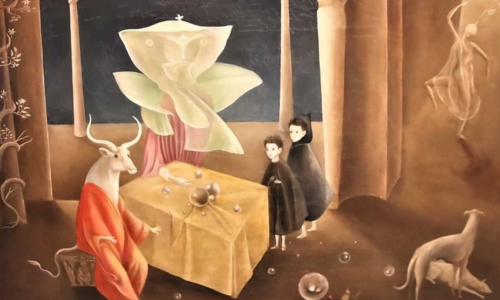
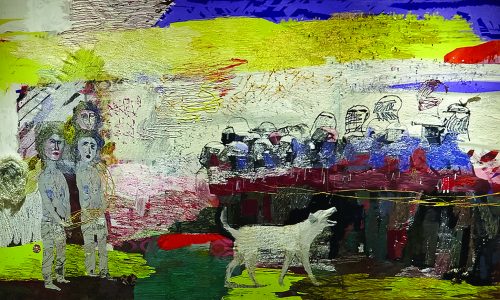
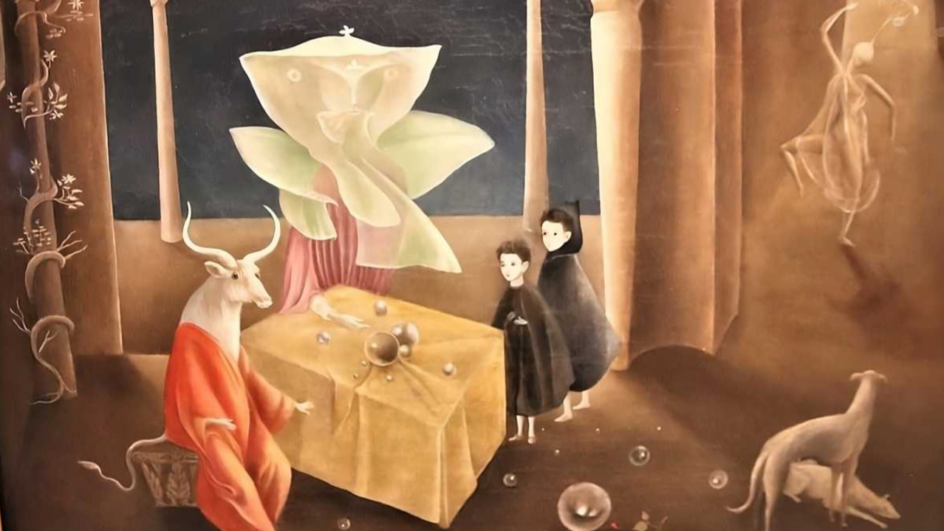
Image Credit: And Then We Saw the Daughter of the Minotaur, 1953, by Leonora Carrington